
‘The Attuning Zone’ exhibition, Peacock & the worm, Aberdeen 2026
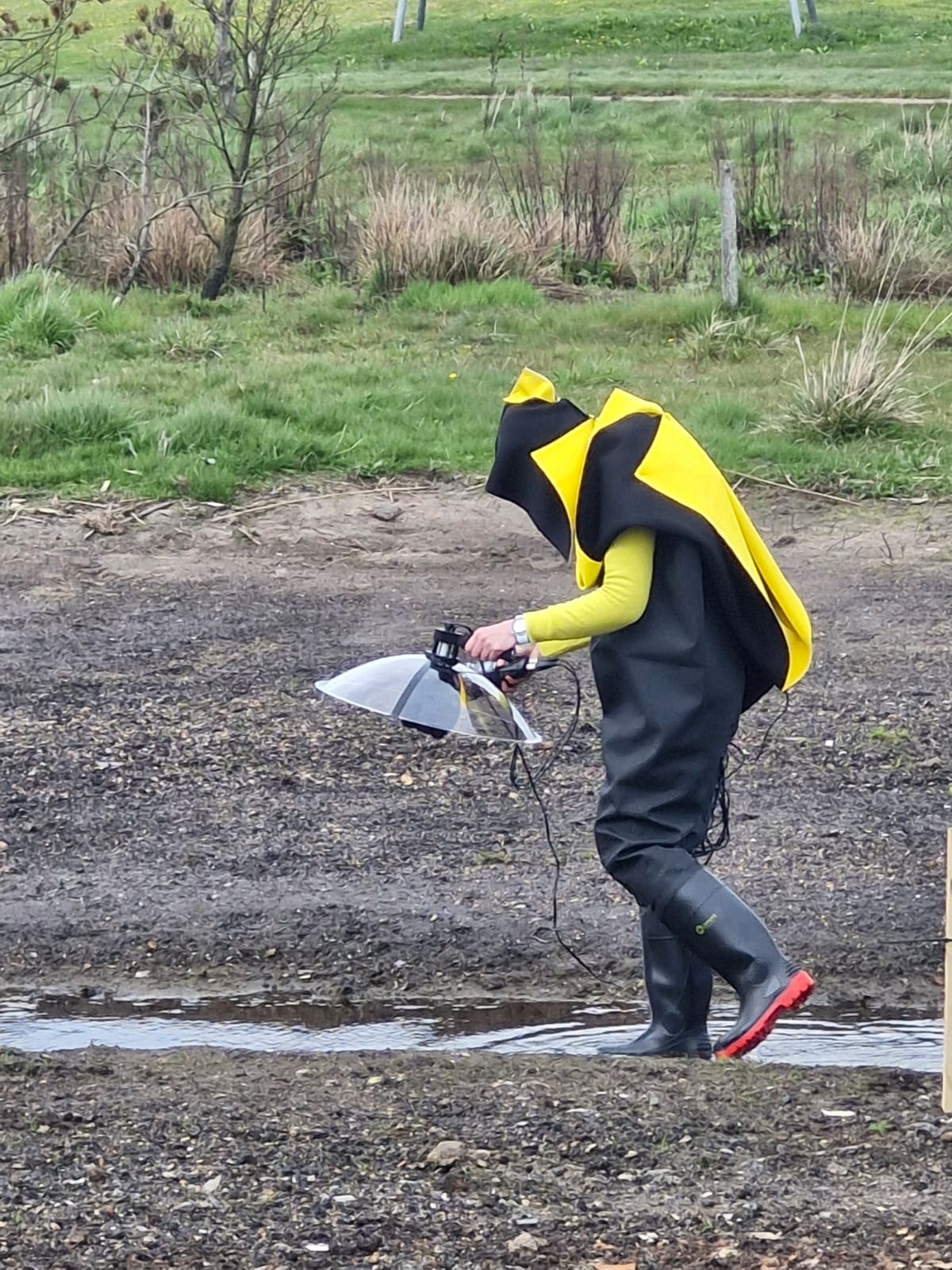
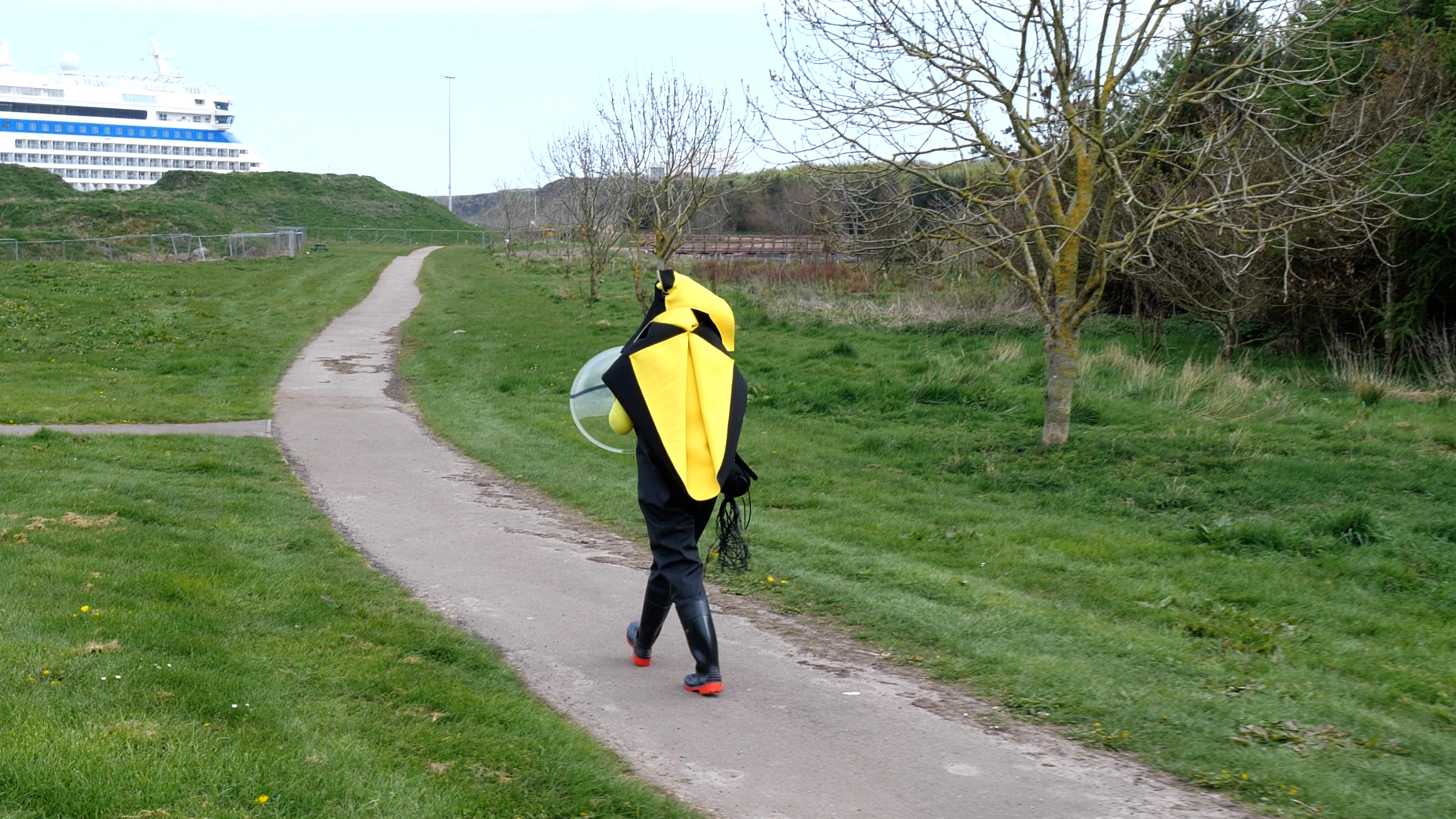
Created as part of ‘The Attuning Zone’ exhibition curated by Rachel Grant in Aberdeen, this performance inhabits the spaces of industrial development, energy transition and rapid environmental change. Dressed in rubber boots, often used as industrial PPE, with a hood and jacket made of neoprene (derived from oil), and equipped with a parabolic microphone and a speaker, Maja amplifies and disrupts the environment during the performance. A yellow and black upper body and red-soled feet might resemble a bird or an insect from a distance, a strange hybrid presence in an environment that might already host cranes and industrial equipment, which are often coloured similarly.
Video documentation: Sasha TSE
The notion of human and non-human relation is voiced quite literally in the performance, as the piece emits intense, shrieking noise modulated by the distance and movement of Maja’s body, and by the distance between the microphone and speaker. Sonically, the piece embraces feedback as a generative and unique voice of this entity-performer. While the microphone gathers a range of sound around Maja, it also picks up its own echo emitted through the speaker, creating a loop that develops uniquely at each iteration of the performance and each site.
At moments futuristic, at others dystopian, the work invites us to inhabit industrial landscapes in transition that often sit on the fringes of our communities. These places speak to our entanglements within energy networks and broader ecological and power relations.
This work first emerged in Aberdeen, a city in the North East of Scotland known as Europe’s oil and gas capital. Situated in St. Fittick’s Park, an area earmarked for further energy transition development, surrounded already by a working harbour, incinerator, and sewage works, the work questions our relationship with landscape and insatiable hunger for further development.
—
This performance was part of the ‘Living with Energy Transition’ project,
a collaborative, interdisciplinary project involving artist-researcher Maja Zećo, anthropologist Gisa Weszkalnys, urbanist William Otchere-Darko, curator Rachel Grant, and in collaboration with community partner Friends of St. Fittick’s Park. Visual artist Phoebe McBride documented the soundwalks through photographs.
The project has resulted in a publication, Living with Energy Transition – Soundwalks in Words (2024) that examines soundwalking as a critical and collaborative form of enquiry. It was also featured in LSE’s magazine Research for the World.
The project received funding from the Economic and Social Research Council (ES/S011080/1), the Department of Anthropology at LSE, and the LSE Engagement and Partnerships Fund. Community partner Friends of St Fittick’s Park were remunerated via funds provided by the transdisciplinary working group ‘Intersecting Energy Cultures’ (The Penn Program in Environmental Humanities, the Kleinman Centre for Energy Policy, University of Pennsylvania, and the Edinburgh Futures Institute, University of Edinburgh).

