
Summerhall, Edinburgh 2022; Look Again, Aberdeen 2022; Historical Museum, Sarajevo 2024; Institute of Contemporary Art, Zagreb 2024
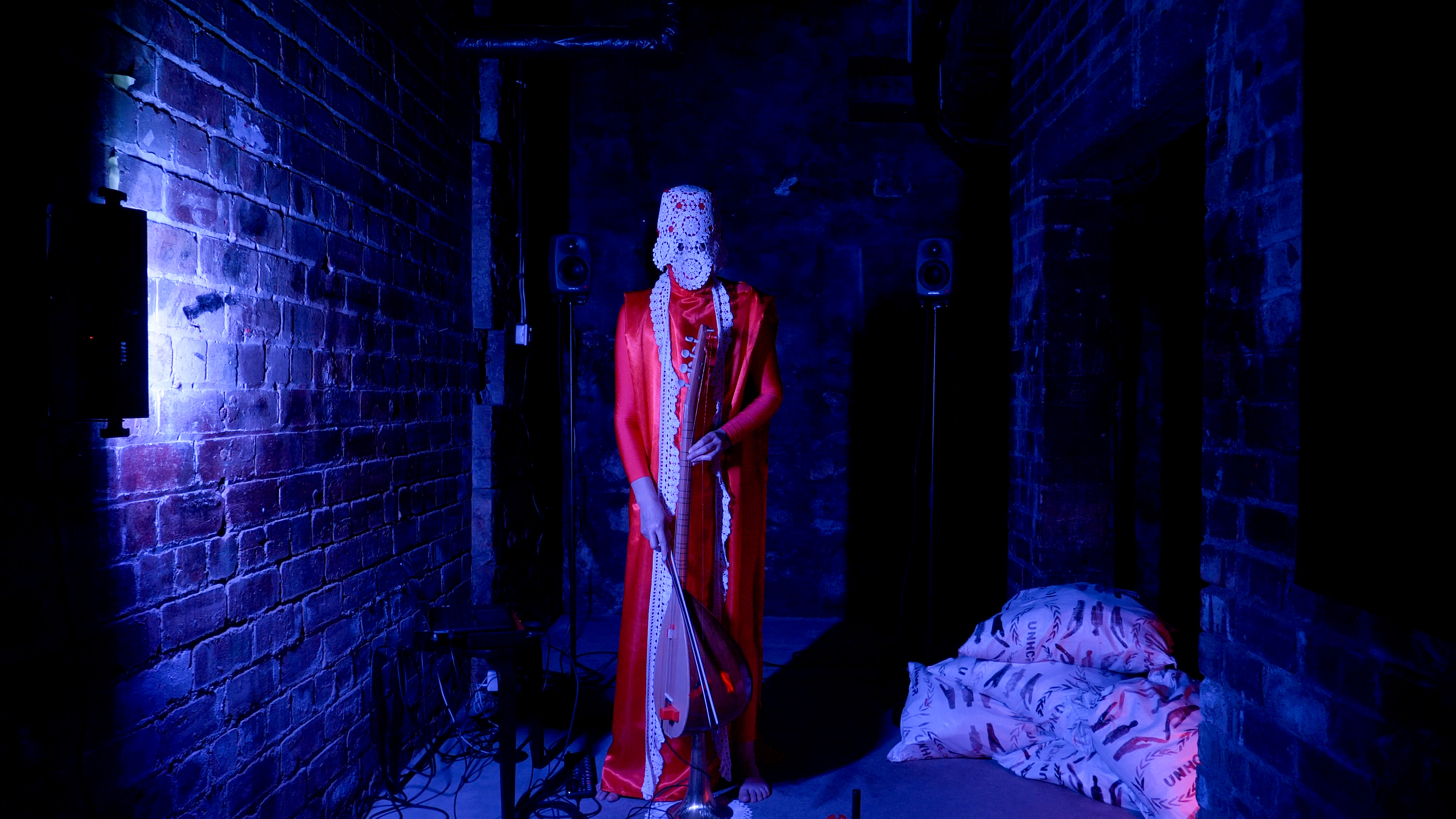
Summerhall, Edinburgh 2022; Look Again, Aberdeen 2022
Dissolutions is a durational performance piece & installation. It was first shown at Summerhall in Edinburgh as part of the exhibition Nothing’s Guaranteed in summer 2022.
This is an overwhelming sensory performance featuring strobe lights, an air raid siren, and an abstract sound-track, deriving from a single recording of a ride in a cable car from Trebević Mountain to Sarajevo city centre.
In the performance, Maja, wears a fez, a red cap usually worn by men, covered with donated lace from Bosnia and North Macedonia. She saws at a saz, a traditional stringed instrument originating in Turkey that, in the context of Bosnia- Herzegovina, her home country, is associated with sevdah folk music, focusing on themes of love and loss. Her atonal sawing of the instrument marks a rejection of the original purpose and the use of the saz as a readymade-style prop in the context of the performance.
The siting of the work in the basement of the galleries, during iterations in Edinburgh and in Aberdeen, was quite deliberate. Basement spaces, rarely visited, dark, full of the strange smells and unfamiliar sounds of a building’s hidden workings- are where many Bosnians sought shelter during the siege of Sarajevo between 1992-95, which the artist lived through as a child. The United Nations High Commission for Refugees (UNHCR) sacks and irregular strobe lighting visualise these unfamiliar surroundings that became normality for many in the Bosnian capital back then- and are the reality for many in cities in Ukraine, Palestine and Yemen, today. There’s a deliberate relationship between the normality of a gallery opening above and the difficult alternative reality in the basement; in a twenty-four hour rolling news culture light hearted party chatter drowns out suffering much more often than it should.
Visually the performance reflects some of Maja’s interests in late modern and contemporary art dating back to FLUXUS and Nam Jun Paik, with the piece perhaps visually referring to Paik’s collaboration with Charlotte Moorman, TV Cello from 1976. The work is also in a lively and densely packed tradition of performance from the former Yugoslavia. But this is a sometimes disturbing and viscerally challenging work that reminds us all, uncomfortably, that our failure to learn lessons from the past has put us in a very challenged relationship with what future may lie ahead of us all.
 Maja Zeco